Key Horeca Results in Summer 2025


The summer of 2023 has brought a series of challenges for Spain’s restaurant industry in its pursuit of a successful season and a satisfying year-end. Although diners have been observed opting for lower-cost options rather than more expensive experiences, not all cities exhibited the same behavior in terms of occupancy and average ticket, rather, each city developed a unique dynamic influenced by various local and national factors.
At Delectatech, we conducted a detailed analysis of the restaurant sector in the six Spanish cities with the highest concentration of establishments (Barcelona, Madrid, Valencia, Bilbao, Seville, and Palma) to examine their performance based on diner traffic, the evolution of the average ticket, and our KPI DelectaRate, which measures each establishment’s reputation and customer satisfaction based on online reviews.
From this analysis, we discovered that restaurant behavior across the six cities has not been uniform. Both customer spending and establishment occupancy have varied significantly.
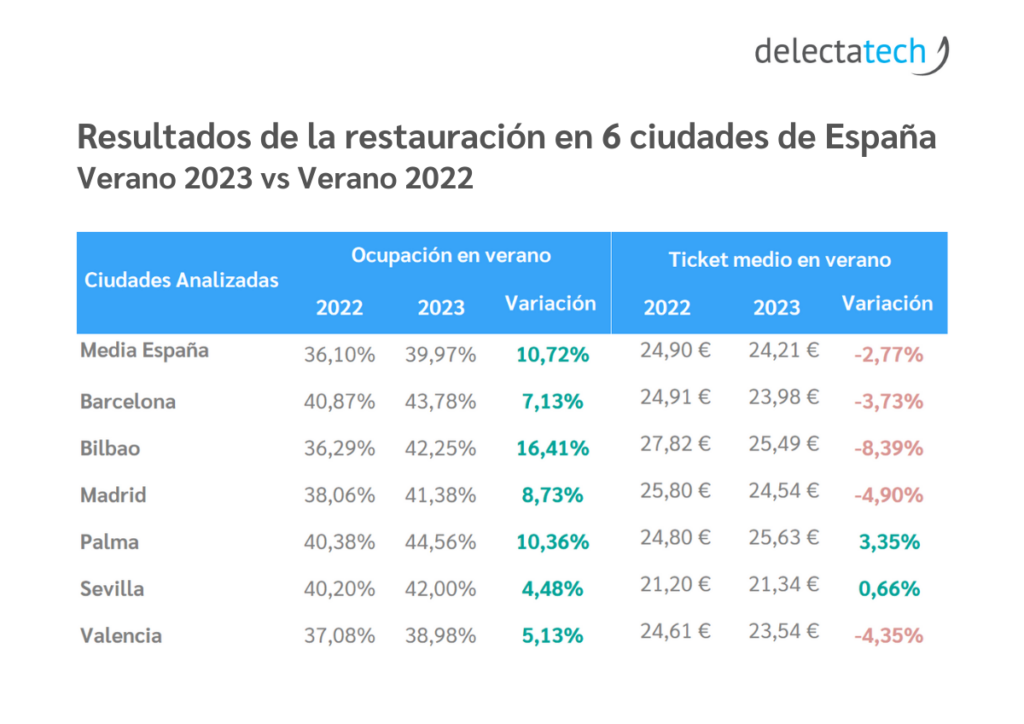
In Barcelona, Madrid, and Valencia, establishments were slightly busier than last year, although the increase in occupancy was below the Spanish average. On the other hand, spending per diner decreased by around 4% in these three cities, also registering a larger drop than the national average.
Palma stood out as the city with the highest summer occupancy (44.56%) and the highest average spend per diner (€25.63). Diners paid more per visit compared to other cities.
Seville experienced high occupancy in its establishments, but its growth was lower than that of the other cities compared to the previous year (4.48%). Additionally, it had the lowest average spend per diner among the cities analyzed (€21.34).
Finally, Bilbao recorded the most positive trend in occupancy compared to the previous summer (+16.42%), but at the same time experienced the largest decline in average ticket (-8.38%).
The six analyzed cities experienced a gradual increase in average occupancy of their establishments during the summer period. However, Seville saw a reduction in diner traffic during July and August, partly due to the high temperatures in those months.
Regarding the evolution of the average ticket, Madrid, Valencia, and Seville reached their peak spend per diner in July, while Barcelona and Palma peaked in August. Similarly, Bilbao recorded a significant increase in spend per diner during that month.
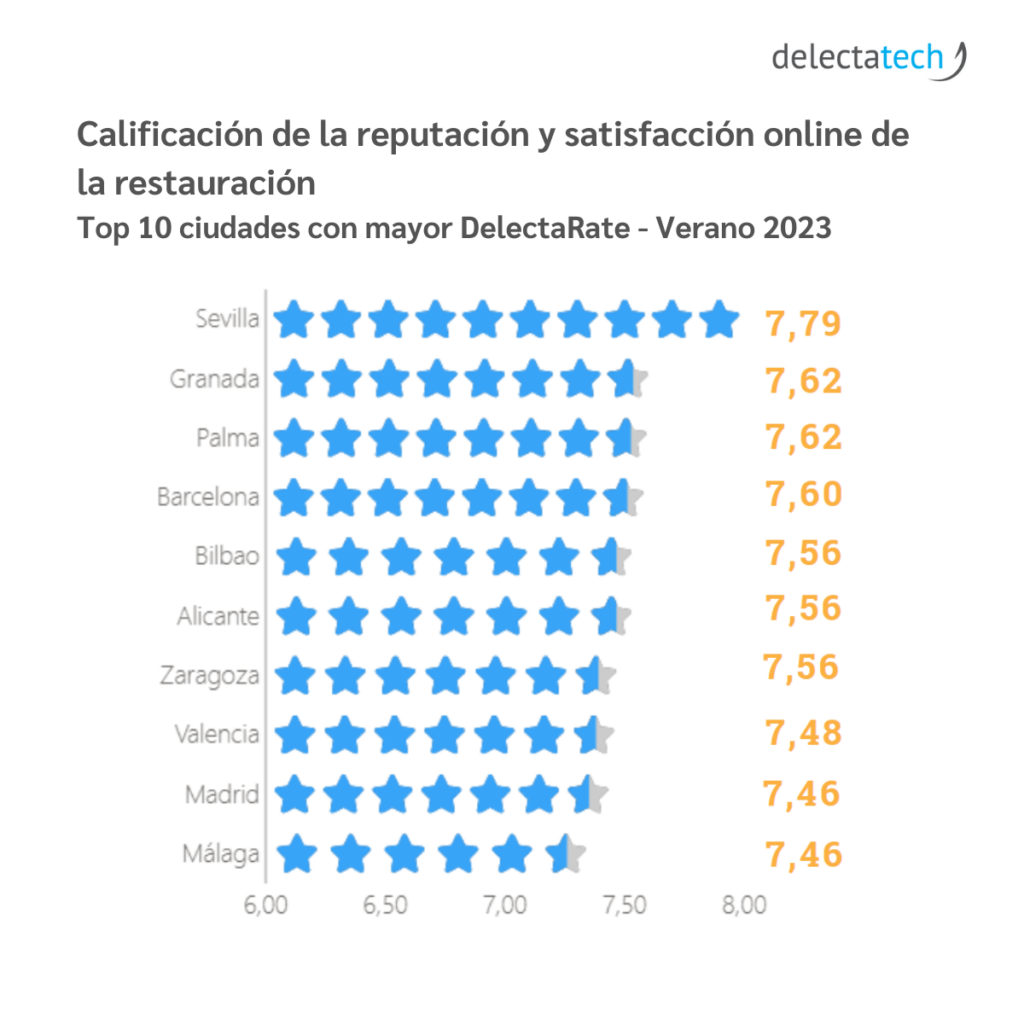
In terms of online reputation and diner satisfaction for establishments ranked by Delectatech, Seville stood out as the “five-star city” with the highest score of 7.79 out of 10 for its dining establishments. In contrast, Madrid received the lowest rating among the analyzed cities, with 7.46.
Spain’s capital experienced a restaurant industry summer characterized by prudence among diners: average spend per diner decreased by -4.88% compared to the previous summer, exceeding the national average decline in Spain (-2.77%).
Despite this, establishments in Madrid saw an 8.72% increase in occupancy compared to the previous summer. Although below the national average, occupancy remained steady throughout the summer months.
In Barcelona, spend per diner decreased by -3.73% compared to summer 2022. However, there was a moderate increase in the average ticket from June to August. In terms of occupancy, performance improved: city establishments recorded a 7.12% increase in occupancy compared to the previous summer.
Valencia establishments experienced a 5.12% increase in occupancy compared to the previous summer. Despite this improvement, average occupancy (38.98%) remained below the Spanish average (39.97%). The city has not yet reached the occupancy levels of most other Spanish cities.
Additionally, Valencia saw a notable variation in average spend per diner, with a -4.35% decrease compared to the previous season, peaking in July.
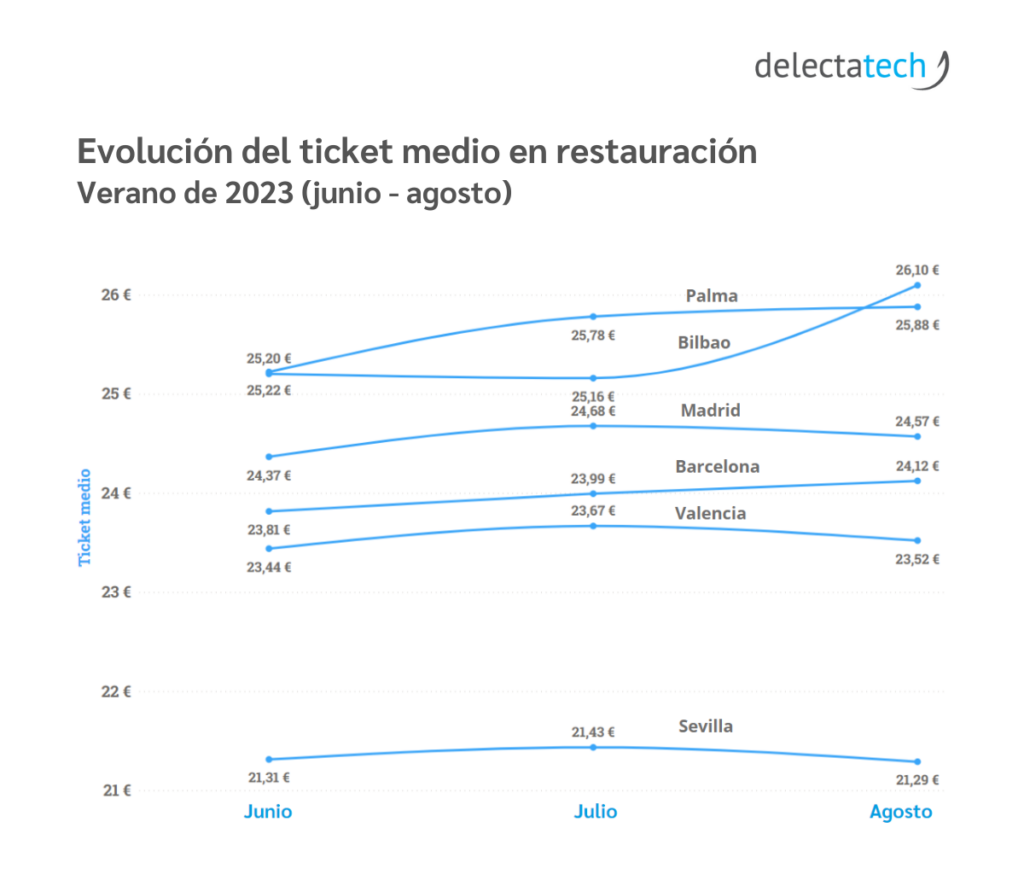
Seville, along with Palma, is one of the few cities that experienced an increase in average spend per diner during the summer, attributed to the growth in the number of restaurants and the reduction of bars, which typically have a lower average price per diner compared to restaurants.
In June, Seville establishments recorded an occupancy rate of 42.04%, which decreased slightly to 41.85% in August—a trend different from other cities, where occupancy continued to rise month by month.
Occupancy in Seville during the summer was closely linked to heat peaks, with August seeing a decline due to temperatures exceeding 40°C. Nevertheless, July saw an increase in occupancy compared to June. It is noteworthy that the analysis of online reputation and diner satisfaction indicates that Seville continues to hold its status as a “five-star” city.
Palma recorded one of the highest average spend per diner, reaching €25.63. The city’s establishment occupancy rate also reached 44.56%, the highest among Spain’s major cities, supported by steady growth throughout the summer months.
Palma’s hospitality sector saw the strongest increase in occupancy, exceeding 10%, along with a 3.35% rise in the average ticket compared to last summer. In Palma, diners not only are willing to pay more per visit but also show higher attendance at establishments.
Bilbao stood out as the second-highest city in Spain for average restaurant spend, maintaining €25.49 per diner during the summer. Notably, 9% of its establishments charge over €50 per person. However, despite this achievement, Bilbao experienced the largest decrease in average spend per diner, dropping from €27.82 to €25.49.
In terms of occupancy, Bilbao registered the highest increase in diner traffic compared to the previous summer, with a 16.42% rise.
Summer 2023 presented various challenges for Spain’s restaurant industry. Despite a general trend toward lower-cost options, significant differences were observed among cities, influenced by factors such as climate, the opening of new establishments, and the diversity of options that constantly drive the sector. This analysis highlights the need to adapt to changing market dynamics and the importance of understanding local preferences to ensure success in Spain’s restaurant industry.
Interested in accessing more data like this? Download the full report “Special Cities: Summer 2023 Results” in our free app, Food Radar, and discover the full potential of Food Data for you.